Category: Scope 3 reporting

  • SBTi Net-Zero Standard V2: Assurance Through the Back Door

    SBTi Net-Zero Standard V2: Assurance Through the Back Door

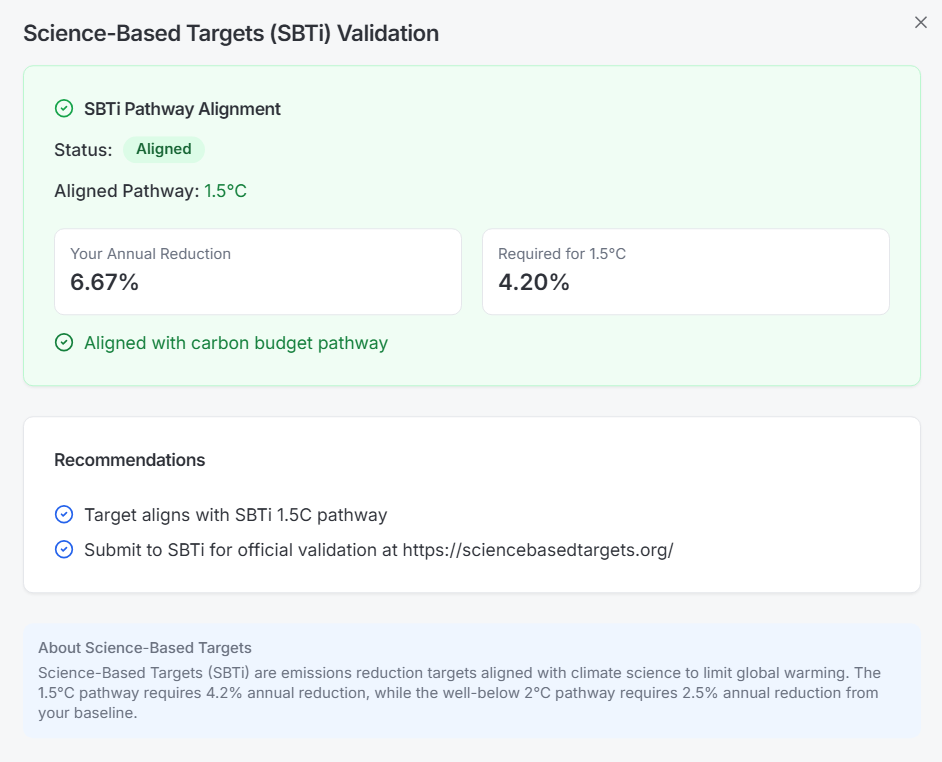
    Horizon ESG science-based targets view comparing a company's annual reduction rate with the rate required for a 1.5C pathway

    In March, a lot of finance teams crossed CSRD off the risk register. The Omnibus raised the threshold to more than 1,000 employees and more than €450m turnover, both tests together, and most mid-sized companies fell out of scope along with the assurance obligation that came with it.

    Some of those companies also hold a science-based target, and the SBTi has just rewritten its rules. Version 2.0 of the Corporate Net-Zero Standard makes independent assurance mandatory for its larger category of company, and its definition of “larger” is far wider than the one in CSRD. This is assurance arriving through a voluntary commitment. Nobody owns it, so nobody budgets for it.


    The dates

    The SBTi published Corporate Net-Zero Standard V2.0 on 11 June 2026. According to the SBTi’s own Main Changes Document, it takes effect on 31 January 2027, followed by a transition period running from Q1 2027 to Q1 2028:

    • From Q1 2027, target validation under V2.0 is available.
    • Until 31 January 2028, companies can still submit targets under V1.3.1 (and the Near-Term Criteria V5.3).
    • From 1 February 2028, every new target submission must align with V2.0.

    Companies that already hold 2030 targets are told to start setting their next cycle (2030 to 2035) under V2.0 from 2028. So the question is when you next submit, and for many companies that is sooner than the 2030 date on the current target suggests.


    Category A: why “we are too small” may not hold

    V2.0 drops the separate SME route and sorts every company into one of two categories. Category A carries the full set of obligations. You are Category A if you meet either of these tests:

    • Any country: net turnover of €450m or more, or 1,000 or more full-time equivalents.
    • High-income countries (using the World Bank classification, which includes the UK): Scope 1 and 2 emissions of 10,000 tCO2e or more, or at least two of a €25m balance sheet, €50m turnover and 250 FTEs.

    Everyone else is Category B. Three details matter for finance. Thresholds are assessed on consolidated group figures, even if your target boundary sits lower in the group. They use the average of your two most recent financial statements. Geography follows the country where the ultimate parent is incorporated.

    Compare that with CSRD. CSRD now needs 1,000 employees and €450m. Category A needs only one of them, and in a high-income country a 300-person business with €60m turnover and a €30m balance sheet qualifies. Plenty of companies that fell out of CSRD scope in March are squarely Category A.


    What Category A has to do

    Assurance, at three points in the cycle

    Criterion CNZS-C7 requires independent third-party assurance of the target base year inventory, at a minimum of limited assurance, covering Scope 1, Scope 2 and Scope 3, low-carbon electricity calculations, significant emissions-intensive activities and any other metric used to set targets. The provider must be an accredited independent third party working to internationally recognised assurance standards. The SBTi says it will set out which frameworks it recognises; in practice many providers will run these engagements under ISSA 5000, the new global assurance standard.

    Any base year recalculation must also be assured (C8.6), as must the data behind your end-of-cycle progress assessment (C37.7). The level of assurance is shown publicly on the SBTi Dashboard.

    A published transition plan

    All companies need a transition plan approved by the board. Category A companies must publish it within 15 months of target validation.

    Scope 3 targets, on a new boundary

    Near-term Scope 3 targets are required for Category A and optional for Category B. The old two-thirds coverage rule is replaced by a significance test: targets must cover every Scope 3 category representing 5% or more of categories 1 to 14 emissions, with limited named exclusions that must be reported and justified.


    The other changes worth knowing

    • Separate Scope 1 and Scope 2 targets replace the combined Scope 1 and 2 target. Scope 2 emissions targets are based on the location-based inventory, with market instruments dealt with separately under a new implementation hierarchy.
    • A target base year built on your latest comprehensive data replaces the historical base year. You can still communicate progress against an earlier year if equivalence is validated.
    • Carbon removals get detailed neutralisation rules on storage durability and double counting, plus a requirement for Category A companies to support removals from 2035.

    One point is widely misunderstood, so it is worth stating plainly: carbon credits still cannot be counted toward your Scope 1, 2 or 3 targets. V2.0 creates a voluntary Ongoing Emissions Responsibility recognition programme for credits and other climate contributions, and the standard says outcomes claimed there cannot be counted toward target implementation or netted from the inventory. Credits sit alongside reductions. They never replace them.


    From “does not apply” to an unbudgeted fee

    A typical case looks like this. The sustainability team set a near-term target in 2022 or 2023. The company is 600 people with €120m turnover, so finance correctly concluded in March that CSRD no longer applies. The next SBTi submission falls in 2028, under V2.0, as Category A.

    Because V2.0 uses your most recent comprehensive data as the base year, a 2028 submission will most likely rest on FY2027 figures. Those figures need limited assurance across all three scopes before validation. FY2027 starts in about three months for a calendar-year company, and the assurance fee and internal time are probably in nobody’s plan.

    Scope 3 is the expensive part. Limited assurance of supplier-derived data, spend-based estimates and emission factor choices tests the documentation behind every number. The practitioner checks that methods are recorded and reproducible and that estimates are labelled. Our post on the six tests an assurance provider actually runs sets out what that looks like in practice.


    What to have in place a year ahead

    • Run the category test now on consolidated, two-year-average figures, and record the result with the workings.
    • Find out when you next submit. Check the SBTi Dashboard and your commitment letter. If it is 2028 or later, plan on V2.0.
    • Treat FY2027 as a probable base year. Fix the boundary and factor sets for the year and attach evidence as data is entered.
    • Re-map Scope 3 against the 5% test and identify which categories will need targets and which exclusions you would have to justify.
    • Talk to an assurance provider this autumn about scope, level and the disclosures they see as high risk.
    • Put the fee and internal time in the FY2027 budget. Where lineage is visible, the practitioner spends less time reconstructing evidence and the fee reflects it.
    • Get the transition plan onto the board agenda, since it needs board approval and, for Category A, publication within 15 months of validation.

    For context on what validation requires under today’s rules, see what SBTi validation actually requires.

    One last point. The SBTi inventory, the numbers in customer questionnaires and any figures in the annual report should come from the same evidenced dataset. When they come from three spreadsheets, the assurance provider will find the gaps before you do.

    Horizon ESG holds datapoint-level lineage, factor source and version on every calculation, labelled estimates, an immutable change log and enforced separation between preparer and approver, the controls a limited assurance engagement on a base year inventory will test. Horizon ESG for finance teams sets out how that works for a controller or CFO. If an SBTi submission is on your horizon, book a short demo and ask us to trace a Scope 3 figure back to its source, live.

    Sources: SBTi Corporate Net-Zero Standard V2.0 (June 2026) and Main Changes Document (11 June 2026); SBTi Corporate Net-Zero Standard page, checked 22 September 2026.

  • How to Answer Customer and Lender ESG Data Requests

    How to Answer Customer and Lender ESG Data Requests

    One ESG dataset mapped to multiple reporting frameworks and questionnaire formats in Horizon ESG

    Somewhere in your inbox right now there is an ESG questionnaire you have not opened yet. It might be from a customer’s procurement portal, from your bank’s annual credit review, or from an insurer’s renewal pack. Each one uses a different format, asks slightly different versions of the same questions, and lands with a deadline that has nothing to do with any regulation.

    If that describes your week, this piece is for you. It covers why the requests keep multiplying even though the EU just cut its reporting rules back, the legal ceiling on what your customers can now require of you, and how to stop answering every request from scratch.


    Why the requests keep coming when the regulation went away

    On 18 March 2026 the Omnibus I Directive came into force and CSRD shrank dramatically. The threshold is now more than 1,000 employees and more than EUR 450m net turnover, both tests together, which cut the reporting population from roughly 50,000 companies to roughly 5,000 across the EU.

    If your company fell out of scope, you might reasonably have expected the questionnaires to slow down. They have not, and the reason is structural. The 5,000 companies still in scope are the largest buyers, banks and insurers in Europe, and their obligations cover their value chains: your emissions, your energy mix, your workforce data, your policies. Banks need supplier and borrower data for financed emissions. Insurers ask at renewal. Procurement teams have embedded ESG scoring in tender processes that are not going to be unwound because a directive changed.

    The obligation did not disappear. It moved, from the regulator to your customers. And that changes the nature of your deadline: it is a tender date, a contract renewal, a credit review. Nobody in Brussels set it, and nobody in Brussels will extend it.


    The value chain cap: the ceiling on what they can require

    Here is the part most suppliers still have not heard. The same Omnibus package that shrank CSRD also gave you a statutory ceiling. If your company has fewer than 1,000 employees, a CSRD-scope customer cannot require you to provide sustainability information beyond what the voluntary VSME standard covers. The European Commission adopted the VSME-based voluntary standard on 3 July 2026, and for CSRD reporters the cap bites from financial year 2027.

    We unpacked the legal mechanics in our earlier piece on what the value chain cap lets buyers still ask suppliers, written for the company sending the questionnaire. This post is the other side of the conversation: what to do when you are the one receiving it.

    Three things to hold onto. First, the cap limits what a customer can require for their CSRD reporting; it does not stop them asking for more, but they must identify which parts of a request go beyond the cap and tell you that you are entitled to refuse those parts. Second, the cap does not stop you volunteering more if it is commercially worth it. Third, the cap is only useful to you if you actually have a VSME dataset to point at, which is the real work.

    How to invoke it without souring the relationship

    The cap is a boundary, not a weapon, and the tone that works is helpful-with-a-ceiling. Something like:

    “We have fewer than 1,000 employees, so under the Omnibus I value chain cap we maintain our sustainability data against the VSME standard. Our full VSME dataset is attached and covers most of your questionnaire. Could you confirm which of the remaining items you need for purposes other than CSRD reporting, and we will see what we can do?”

    You have answered fast, answered most of it, stated the legal position without threatening anyone, and moved the burden of justifying the excess back to the requester. That is a very different conversation from either silence or a flat refusal.


    One dataset, many formats

    The deeper fix is to stop treating each questionnaire as a document to be written and start treating it as a view of a dataset you already maintain.

    The VSME standard is the natural spine for that dataset, because it is now the reference point for what you can be required to provide. Build it once: energy and emissions, workforce basics, policies, certifications, incidents. Attach the evidence to each datapoint, not to a folder, so that every answer you send out carries its source with it. Then each new request, whatever the format, becomes a mapping exercise rather than a writing exercise.

    The consistency matters as much as the speed. When five people answer five portals from memory and spreadsheets, the same question eventually gets five slightly different answers, and one of them ends up contradicting the number your company published elsewhere. One maintained dataset is what prevents that.

    This is the problem Horizon ESG’s sustainability team workspace is built around: one evidenced dataset, mapped to the frameworks and questionnaire formats you actually get asked for. Nova, the built-in assistant, drafts questionnaire answers from that dataset, with every figure traced to its source and every draft held for your approval before anything leaves the building.


    When a customer asks for more than the cap allows

    It will happen, usually because the person running the portal has never heard of the cap. A short sequence to work through:

    • Check the purpose. The cap governs requests made for CSRD reporting. Data requested for contract qualification, product compliance or the customer’s own risk management sits outside it. Ask which is which; the question itself often shrinks the request.
    • Ask them to flag the excess. A CSRD-scope buyer asking beyond the cap is supposed to identify which items exceed it and tell you they are optional. If they have not, asking them to do so is entirely reasonable.
    • Decide commercially, not defensively. The cap gives you a right to decline, not a duty. If a strategic customer wants two extra datapoints and you can produce them from your dataset in an hour, volunteer them.
    • Counter-offer the dataset. “Here is our complete VSME dataset now; the remaining items would take us six weeks” gives the requester something to bank immediately and usually ends the conversation.

    The commercial cost of answering slowly

    It is tempting to treat questionnaires as overhead to be minimised. The evidence in front of most sustainability officers points the other way: the requests you are receiving are attached to revenue and to the cost of capital. A tender response that misses the portal deadline is a bid not scored. A slow answer to a bank’s ESG review does not usually lose the loan, but sustainability-linked facilities increasingly tie margin to data quality, and “supplier could not evidence their numbers” is a phrase that shows up in credit files.

    Being easy to buy from is the quiet advantage here. The supplier who returns a complete, evidenced, consistent dataset in two days is doing more for renewal season than most marketing budgets.


    One dataset, two audiences

    A last point worth raising internally: the numbers you send to customers and lenders need to match the numbers your finance team publishes. When the two are produced separately, they eventually diverge, and a customer noticing the difference is the worst possible way to find out. If your CFO is starting to ask assurance-flavoured questions about sustainability data, that is the same problem from the other end; our page for finance teams covers that side.

    If your week is currently being eaten by questionnaires, book a short demo and bring your worst one. Answering it from one dataset is the fastest way to see the point.

  • UK SRS S1 and S2: Who Has to Report, and When

    The UK’s sustainability reporting standards have been finished for six months and almost nobody has started. That is not negligence, it is a rational response to an unfinished sentence: the standards exist, but the rule that makes them binding does not. It is expected this autumn.

    Which makes now the useful moment to understand them, rather than the moment after the announcement when every consultant in London is quoting you a readiness assessment.


    Where things actually stand

    The Department for Business and Trade published the final UK SRS S1 and UK SRS S2 on 25 February 2026. They are available for voluntary use by any entity today, and a handful of companies have already adopted them early.

    The binding step sits with the Financial Conduct Authority. Its consultation, CP26/5, ran from 30 January to 20 March 2026 and proposed replacing the current TCFD-aligned listing rules with UK SRS. The FCA has said it aims to publish the final Policy Statement in autumn 2026. As of today it has not.

    Everything below the standards themselves is therefore still a proposal. It is a well-signalled proposal that has already been through consultation, which is not the same thing as a rule.


    The distinction that matters most: this is ISSB, not ESRS

    If your team spent 2024 and 2025 building for CSRD, the single most important thing to understand about UK SRS is that it did not come from the same place.

    UK SRS S1 and S2 are endorsed versions of IFRS S1 and IFRS S2, the ISSB standards, with only limited UK amendments. They are not derived from the ESRS. The practical consequences are real:

    • Materiality is single, not double. ISSB asks what could reasonably be expected to affect an entity’s prospects – cash flows, access to finance, cost of capital. It does not ask you to report impacts on people and planet that are not financially material. Your CSRD double materiality assessment is useful input, but it is not the same assessment.
    • The audience is investors, explicitly and narrowly. That changes the register of the disclosure and often the level of aggregation.
    • There is no ESRS datapoint list to work through. ISSB is principles-based with industry-specific metrics drawn from SASB. Teams used to filling in a defined set of datapoints find this harder, not easier, because judgement is now load-bearing.

    The overlap is nonetheless substantial at the data layer. Emissions are emissions; governance narrative is largely reusable; scenario analysis carries over. It is the framing, materiality boundary and reporting location that differ. We covered the mechanics of that mapping in more detail in our piece on how TCFD and CSRD requirements line up for UK companies.


    Who is in scope

    The FCA’s proposals apply to listed issuers in five UK Listing Rules categories: commercial companies (UKLR 6), secondary listings (UKLR 14), depositary receipts (UKLR 15), non-equity and non-voting equity shares (UKLR 16), and the transition category (UKLR 22).

    That is roughly 515 companies. For context, post-Omnibus CSRD now catches around 5,000 companies across the entire EU, so neither regime is the mass-market obligation the 2023 architecture implied.

    If you are a private UK company, you are not in the FCA’s population. You may still receive UK SRS-shaped questions from listed customers and from lenders, which is a different problem with the same answer.

    The timetable, as proposed

    • UK SRS S2 (climate): accounting periods beginning on or after 1 January 2027. For a December year end, that means the report published in 2028.
    • Scope 3 emissions: a one-year transitional relief, applying on a comply-or-explain basis for periods beginning on or after 1 January 2028.
    • UK SRS S1 (wider sustainability): a two-year relief, comply-or-explain for periods beginning on or after 1 January 2029.

    Read that phasing carefully, because it is the opposite of how most companies sequence their work. Climate lands first and hardest. Scope 3, the hardest data problem in the standard, gets one extra year and then arrives on comply-or-explain, which in practice means “report it or write a paragraph explaining a gap to your investors”. Neither is a reason to defer the work; both are a reason to sequence it properly.


    What happens to your TCFD disclosures

    If you have been reporting under the FCA’s TCFD-aligned rules, you are not starting from zero. IFRS S2 was built on the TCFD’s four pillars, and governance, strategy, risk management, and metrics and targets survive intact as the structure of the disclosure.

    What is genuinely new is the level of specificity:

    • Industry-based metrics. S2 points to SASB-derived metrics for your sector. TCFD left this open; S2 does not.
    • Scope 3 across all fifteen categories, with the measurement approach and inputs disclosed, rather than a partial inventory with a footnote.
    • Connectivity with the financial statements. The assumptions behind your climate disclosure are expected to be consistent with the ones behind your accounts. Asset lives are the classic exposure.
    • Transition plans. The FCA is not proposing to mandate one. It is proposing that you disclose whether you have published one and where it can be found, or why you have not – which is a harder question to answer blandly than it looks.

    The assurance line most readers skipped

    CP26/5 does not mandate third-party assurance. It proposes something quieter: that in-scope companies state in the annual financial report whether they obtained assurance, from whom, over which disclosures, to what level, against which standard, and where the report sits.

    A visible blank is a disclosure in itself. Once one FTSE 250 peer names a provider and a standard, the field fills in fast. Anyone who watched limited assurance arrive in Europe will recognise the shape of it – and the preparation it demands is the same as we set out in our guide to what limited assurance actually tests: documentation, traceability and controls, not recalculated totals.


    SECR has not gone anywhere

    Worth saying plainly, because the UK SRS coverage tends to imply otherwise. Streamlined Energy and Carbon Reporting still applies to all UK quoted companies and to large unquoted companies and LLPs meeting the familiar size test. That population is an order of magnitude larger than the FCA’s 515, and nothing in UK SRS removes the obligation. If you are a large private company, SECR remains your binding UK requirement and UK SRS is, for now, context.


    What to do before the Policy Statement lands

    • Establish whether you are in one of the five UKLR categories. Ten minutes, and it determines everything else.
    • Re-run materiality on a single-materiality basis if your existing assessment was built for CSRD. Do not assume the answer transfers.
    • Baseline Scope 3 now, not in 2028. The relief is on the reporting date, not on the data collection, and purchased goods and services cannot be built in a quarter.
    • Check connectivity between your climate assumptions and the assumptions in your financial statements. Fix the inconsistencies while nobody is examining them.
    • Decide your assurance position early. If you intend to say “assured”, the provider needs to see your controls well before the reporting period, not after it.
    • Read the Policy Statement when it appears and re-check the dates. Consultation feedback moves timetables, and these are still proposals.

    The companies that will find UK SRS straightforward are not the ones with the most disclosure experience – they are the ones that can show where each number came from. Horizon ESG helps UK reporting teams collect data once and keep source, method, factor version and owner attached to every figure, so the same evidence base serves UK SRS, SECR, ISSB and customer data requests without a rebuild each cycle. If you are still choosing a platform, our comparison of eight ESG reporting platforms sets out which ones cover ISSB properly rather than treating it as a CSRD add-on. See how it works for UK reporting, or book a free demo.

  • SB 253 Deadline: Three Reliefs Buried in CARB’s Redline

    The nearest binding climate-reporting deadline anywhere in the world is not in Brussels. It is 10 November 2026, when the first Scope 1 and Scope 2 disclosures under California’s SB 253 fall due — around fourteen weeks from now. And the document that decides how hard that filing will actually be was published on 27 July, arrived as a redline, and has been read by almost nobody outside the law firms.

    On that date the California Air Resources Board published its modified initial regulation implementing SB 253 and SB 261, and opened a 15-day public comment period closing 11 August 2026. Most coverage led with the deadline deferral — from 10 August to 10 November — already known since June. Further down the text sit three first-year concessions that materially change what an in-scope company has to produce this year, each the kind of provision that vanishes in a press-release summary.


    First, what this document is — and isn’t

    It is a modified text out for comment, not a final rule: it still has to clear the comment period and review by the Office of Administrative Law before it binds. Treat what follows as a strong signal of CARB’s intent rather than settled law — while not planning a fourth-quarter data sprint as though none of it exists.

    The scope test is unchanged: companies with total annual revenue above $1 billion that do business in California. The first report covers FY2025 Scope 1 and Scope 2 emissions, due 10 November 2026.


    Relief one: the 5 December 2024 data cut-off

    For initial reporting only, a company may rely on information it possessed, or was already in the process of collecting, as of 5 December 2024.

    Read that slowly, because it inverts the instinct most teams are acting on. The benchmark for your first California filing is not the best inventory you could assemble by November — it is the inventory your systems were already producing more than eighteen months ago. If utility data for a set of leased sites was never metered separately in 2024, CARB’s text does not require you to reconstruct it now.

    The practical effect is that the sensible first-year project is narrower than most teams have scoped it. Rather than retro-instrumenting every site, the work is to establish what you genuinely held at that date, report on that basis, and document the boundary clearly enough that it survives a later question. That is a governance and evidence exercise more than a measurement one — the same discipline that applies whenever estimated data is good enough to report: state the method, state the limitation, keep the trail.

    What it does not do

    It is explicitly a first-year provision. It does not waive the obligation to file, and it does not carry into the 2027 cycle — by which point the expectation is a properly built inventory. Nor is it self-executing: relying on it means being able to evidence what you held and when. A company that quietly uses the relief without recording why has taken the risk without the protection.


    Relief two: intercompany revenue is out of the $1 billion test

    The modified text clarifies that revenue transmitted between a parent and a subsidiary, or between different parts of the same company, is not counted as revenue when applying the $1 billion threshold.

    This matters more than it sounds. Groups running captive distribution entities, internal manufacturing transfers or centralised procurement can show gross figures well above the threshold that are substantially internal turnover. An entity that looked comfortably in scope may not be in scope at all once genuine third-party revenue is isolated.

    If your scoping decision was made in 2025 on a quick read of group revenue, re-run it before you commit a reporting budget. Threshold questions are cheap to answer now and expensive to answer in November.


    Relief three: one consolidated report for the group

    The modified regulation permits a parent company to submit a consolidated report covering its in-scope subsidiaries, rather than requiring each entity to file separately. Fees are still assessed on a per-company basis, so this is an administrative simplification rather than a financial one.

    The value is in coherence. One filing means one organisational boundary, one consolidation approach, one set of emission factors and one assurance conversation — instead of several subsidiary submissions that anyone can lay side by side and find inconsistent.

    One caveat: the consolidated boundary you use for California should reconcile to the consolidation approach in your GHG inventory and to whatever you publish elsewhere. A boundary chosen for administrative convenience creates a discrepancy you will spend years explaining.


    What the reliefs don’t touch

    Scope 3 arrives in 2027 — but only five categories

    CARB has signalled a phased approach for the 2027 cycle, with initial Scope 3 reporting focused on five commonly reported categories rather than all fifteen: purchased goods and services, fuel- and energy-related activities, waste generated in operations, business travel, and employee commuting, with flexibility around de minimis categories.

    That is a genuine sequencing instruction, and it is unusual to be handed one. Four of the five can be built largely from data your finance and HR systems already hold. The fifth — purchased goods and services — takes a year, because it depends on spend categorisation and supplier engagement rather than a single system. That is your critical path.

    Assurance is coming, on a proposed schedule

    CARB’s proposals introduce limited assurance over Scope 1 and Scope 2 from qualified independent providers, recognising several standards families — AICPA, IAASB and ISO-based frameworks among them — with a move toward reasonable assurance signalled around 2030. The detail is still in play; the direction is not. If you have been through limited assurance under CSRD, you know the real cost is not the auditor’s fee. It is having evidence attached to every number.

    SB 261 is still enjoined — SB 253 is not

    These two laws are routinely discussed together but sit in very different positions. The Ninth Circuit enjoined enforcement of SB 261, the climate-risk reporting law for companies above $500 million in revenue, on 18 November 2025 pending appeal; oral argument was heard on 9 January 2026 and, at the time of writing, no merits decision has been published. SB 253 was not enjoined. Its deadline is live. Anyone who paused California work on the strength of “the courts blocked it” has confused the two.


    Fourteen weeks: a working sequence

    • Re-run the threshold test on third-party revenue only, excluding intercompany turnover, and write down the answer with its basis.
    • Establish your 5 December 2024 position. What Scope 1 and Scope 2 data did you hold, or have in collection, at that date? That list defines the scope of your first report.
    • Decide the filing structure — consolidated at parent level or entity by entity — and check the boundary reconciles to your existing inventory.
    • Comment by 11 August if any of the three provisions is ambiguous for your structure — the last low-cost way to influence the text.
    • Separate the FY2025 filing from the 2027 build. Different projects, different standards of rigour; merging them is how first-year filings become nine-month programmes.
    • Start purchased goods and services now, not in 2027. It is the only one of the five categories that cannot be delivered in a quarter.

    The pattern is familiar. As we argued when the SEC’s climate rollback failed to free US multinationals, federal deregulation has not reduced disclosure obligation — it has moved it to states and to Europe, where the timetables are statutory and the reliefs are technical rather than political.


    If 10 November is on your calendar, the question is not how much data you can gather — it is how much you can evidence. Horizon ESG helps teams collect emissions data once, keep the audit trail attached, and report it against SB 253, CSRD and ISSB without rebuilding the inventory each time. Book a free demo.

Book Your Free Demo