Category: ESG Reporting software

  • CSRD Readiness Checklist: 12 Steps Before Your First Report

    To prepare for CSRD, organisations should follow a structured readiness process: confirm whether they fall in scope, identify their reporting deadline, conduct a double materiality assessment, map their value chain, establish data collection workflows, and secure assurance early. This 12-step CSRD readiness checklist walks you through each stage so you can approach your first report with confidence rather than last-minute scrambling.

    What Is CSRD Readiness?

    CSRD readiness refers to the state of organisational preparedness required to produce a compliant sustainability report under the EU’s Corporate Sustainability Reporting Directive. Unlike previous non-financial reporting requirements, the CSRD demands structured, auditable disclosures aligned with the European Sustainability Reporting Standards (ESRS). That means readiness is not simply about writing a report — it is about building the internal systems, governance structures, and data pipelines that make accurate, verifiable reporting possible.

    A CSRD readiness assessment evaluates where your organisation currently stands against these requirements and identifies the gaps you need to close before your first filing deadline. The earlier you begin this process, the less disruptive it becomes. Companies that treat CSRD preparation as a phased project — rather than a year-end compliance exercise — consistently report smoother outcomes and fewer audit issues.

    The 12-Step CSRD Readiness Checklist

    1. Determine If You Are in Scope

    The CSRD is rolling out in waves. Large public-interest entities (over 500 employees) began reporting in 2025 on FY2024 data. The second wave, covering large companies meeting two of three thresholds — over 250 employees, EUR 50 million turnover, or EUR 25 million in assets — reports in 2026 on FY2025 data. Listed SMEs follow in 2027, with a possible opt-out until 2028. Non-EU companies generating over EUR 150 million in the EU enter scope from 2029. Check the thresholds carefully. Many mid-sized businesses are surprised to find they qualify earlier than expected, particularly subsidiaries of larger groups.

    2. Identify Your Reporting Year and First Filing Deadline

    Once you have confirmed you are in scope, pin down the exact financial year you need to report on and the corresponding filing date. Your CSRD report will be included within your management report, which means the deadline aligns with your annual financial reporting cycle. If you are in the second wave, your first report covers FY2025 data and must be filed in 2026. This distinction matters because data collection needs to begin at the start of the reporting year — not when the report is due. Work backwards from the filing date to build a realistic preparation timeline.

    3. Conduct a Gap Analysis Against ESRS Requirements

    The European Sustainability Reporting Standards comprise 12 standards spanning environmental, social, and governance topics. Each standard contains specific disclosure requirements and data points. A gap analysis maps your current ESG reporting practices against these requirements to identify what you already collect, what you partially cover, and what is entirely missing. Focus on the mandatory cross-cutting standards (ESRS 1 and ESRS 2) first, then move to the topical standards that your double materiality assessment identifies as relevant. This exercise gives you a clear remediation roadmap and helps you prioritise resource allocation.

    4. Complete Your Double Materiality Assessment

    Double materiality is the foundation of your CSRD report. It requires you to assess sustainability topics from two perspectives: financial materiality (how sustainability issues affect your business) and impact materiality (how your business affects people and the environment). This assessment determines which ESRS topical standards you must report on and which you can legitimately exclude. It also shapes your stakeholder engagement strategy. For a detailed walkthrough of the methodology, see our complete guide to double materiality under CSRD. Do not underestimate the time this step requires — most organisations need 8 to 12 weeks to complete it properly.

    5. Map Your Value Chain for Scope 3 Reporting

    ESRS E1 (Climate Change) requires disclosure of Scope 1, 2, and 3 greenhouse gas emissions. Scope 3 — covering indirect emissions across your upstream and downstream value chain — is typically the largest category and the hardest to measure. Begin by mapping your key suppliers, distributors, and end-of-life product impacts. Identify which Scope 3 categories are most material to your business. You will likely need to rely on spend-based estimates initially before transitioning to activity-based data over time. Engaging key suppliers early and establishing data-sharing agreements will improve data quality in subsequent reporting cycles.

    6. Establish Data Collection Processes Across Departments

    CSRD reporting pulls data from across the entire organisation — HR for workforce metrics, procurement for supply chain data, facilities for energy consumption, finance for climate-related financial risks. Identify every data owner and establish clear collection processes, frequencies, and quality standards. Spreadsheets may work for a first cycle, but they introduce error risk and make audit trails difficult. Investing in purpose-built ESG reporting software early reduces manual effort and improves consistency. Define data definitions clearly so that every department reports metrics in the same way.

    7. Assign Internal Ownership and Governance Structure

    CSRD compliance cannot sit with a single sustainability officer. It requires a governance structure with clear accountability at the board level, an executive sponsor, and designated owners for each ESRS topic. Consider establishing a cross-functional CSRD steering committee that includes representatives from finance, legal, operations, HR, and sustainability. Define who signs off on the final report, who is responsible for data quality, and how disputes over materiality or disclosure are resolved. Our guide on CSRD governance alignment provides a practical framework for structuring this effectively.

    8. Select Your Reporting Software Platform

    The complexity and volume of ESRS data points make manual reporting impractical at scale. Evaluate ESG reporting software platforms based on their ESRS alignment, data integration capabilities, audit trail functionality, and XBRL tagging support — since CSRD reports must be digitally tagged in European Single Electronic Format (ESEF). Consider whether the platform supports double materiality workflows, automated data validation, and multi-entity consolidation if you operate across subsidiaries. Select your platform early enough to allow for implementation, data migration, and user training before the reporting year begins.

    9. Build Your Audit Trail from Day One

    CSRD reports are subject to mandatory assurance — initially limited assurance, moving to reasonable assurance over time. Your assurance provider will need to trace every disclosed figure back to its source. This means maintaining documentation of data origins, calculation methodologies, assumptions, estimation techniques, and any manual adjustments. Build this audit trail from the very start of your data collection process, not retrospectively when the auditor arrives. Version control for documents, approval workflows for data submissions, and timestamped records of changes all contribute to a robust audit trail that will make assurance smoother and less costly.

    10. Engage Your Assurance Provider Early

    Do not wait until your report is drafted to approach an assurance provider. Engage them during the preparation phase so they can review your methodology, flag potential issues with data quality or materiality conclusions, and confirm that your processes meet assurance standards. Many audit firms are experiencing significant demand as thousands of companies enter CSRD scope simultaneously, so early engagement also secures capacity. If your financial auditor offers sustainability assurance, there may be efficiencies in using the same firm, but evaluate independence and expertise carefully. A pre-assurance readiness review can save considerable time and cost later.

    11. Train Your Team on ESRS Disclosure Requirements

    CSRD reporting is not just a sustainability team exercise. Finance teams need to understand climate-related financial disclosures. HR must know what workforce data is required and how to report it consistently. Board members need sufficient literacy to oversee and approve the report. Invest in targeted training that is role-specific rather than generic. Focus on the practical mechanics: what data each team needs to provide, in what format, by what deadline, and to what quality standard. Regular briefings throughout the reporting cycle keep teams aligned and reduce the risk of last-minute data gaps or inconsistencies.

    12. Create a Reporting Timeline with Internal Milestones

    Your CSRD preparation needs a detailed project plan with clear milestones, not just a filing deadline. Work backwards from your submission date and build in time for data collection close, internal review cycles, management sign-off, assurance fieldwork, and XBRL tagging. Allow buffer time — first-year reporting always takes longer than expected. Key milestones should include: completion of the double materiality assessment, data collection cut-off dates for each quarter, first draft review, assurance readiness review, board approval, and final submission. Assign owners to each milestone and track progress through regular steering committee meetings.

    Common CSRD Readiness Mistakes

    Even well-resourced organisations stumble during CSRD preparation. These are the mistakes we see most frequently:

    1. Starting too late. Companies that begin their readiness assessment less than 12 months before their filing deadline consistently struggle with data gaps and rushed disclosures. CSRD preparation is a multi-year journey, not a quarter-end sprint.
    2. Treating it as a sustainability-only project. Without buy-in and active participation from finance, legal, HR, and operations, data collection stalls and governance gaps appear during assurance.
    3. Underestimating double materiality. A superficial materiality assessment leads to either over-reporting (wasting resources on immaterial topics) or under-reporting (creating compliance risk). Invest the time to do it properly.
    4. Ignoring the audit trail. Collecting data without documenting sources, methodologies, and assumptions creates enormous problems when assurance providers request evidence. Retrofitting audit trails is far more expensive than building them from the start.
    5. Choosing software too late. Implementing a reporting platform mid-cycle forces dual processes and increases error risk. Select and configure your platform before the reporting year begins.
    6. Neglecting value chain data. Scope 3 and supply chain disclosures require supplier engagement that takes months to establish. Start building those relationships and data-sharing agreements early.

    How Horizon ESG Supports CSRD Preparation

    Horizon ESG provides a structured platform designed to guide organisations through each stage of CSRD compliance. From automated double materiality workflows to ESRS-aligned data collection templates, the platform helps teams move from readiness assessment to published report without relying on disconnected spreadsheets or manual processes.

    Key capabilities include built-in audit trail functionality, cross-departmental data collection with automated validation, Scope 1-3 emissions calculation, and XBRL-ready output. For organisations in the second and third CSRD waves, Horizon ESG offers a phased onboarding approach that aligns platform implementation with your reporting timeline — so you are collecting data in the right format from day one.

    Learn more about how the platform supports your reporting obligations on our CSRD solutions page, or explore our guide to selecting best-practice ESG reporting software.

  • Automated ESG Reporting: How AI Cuts Effort 70%

    Automated ESG Reporting: How AI Cuts Effort 70%

    The Manual Reporting Problem

    ESG reporting has traditionally been a manual, resource-intensive process. Sustainability teams spend weeks collecting data from dozens of sources, matching activities to emission factors, chasing missing information, reconciling inconsistencies, and drafting narrative disclosures. For organisations reporting under CSRD, GRI, CDP, and other frameworks simultaneously, the workload multiplies with every standard.

    Artificial intelligence is changing this equation fundamentally. Organisations that deploy AI-powered ESG automation are reducing manual reporting effort by up to seventy percent — not by cutting corners, but by automating the repetitive tasks that consume the most time while maintaining the accuracy and rigour that regulators and auditors demand.

    What AI Actually Does in ESG Reporting

    Automated Data Collection

    AI-powered platforms connect to your existing business systems — ERP, HR, energy management, procurement, travel booking — and extract ESG-relevant data automatically. Instead of sending spreadsheet templates to facility managers and waiting weeks for responses, the system pulls utility consumption, headcount data, travel records, and procurement spend on a scheduled basis. Learn more about how AI automation works in practice.

    Intelligent Emission Factor Matching

    One of the most time-consuming tasks in carbon reporting is matching activity data to the correct emission factors. AI analyses your activity descriptions, units, geographies, and source categories to suggest the most appropriate emission factors from databases like DEFRA, EPA, ecoinvent, and IPCC. The system learns from your corrections, improving accuracy over time. This capability alone can save dozens of hours per reporting cycle, particularly for complex carbon accounting across Scope 1, 2, and 3.

    Gap Detection and Anomaly Flagging

    AI continuously monitors your data for completeness and consistency. It identifies missing data points before they become audit findings, flags statistical anomalies that may indicate errors — such as a facility reporting ten times its typical energy consumption — and highlights year-over-year changes that require explanation. This proactive approach means your team catches problems early rather than discovering them during assurance review.

    Narrative Drafting

    CSRD and other frameworks require extensive narrative disclosures alongside quantitative data. AI assists by generating first drafts of narrative sections based on your data, policies, and previous reports. These drafts are starting points, not final outputs — your sustainability experts review, refine, and approve every disclosure. But starting from a structured draft rather than a blank page saves significant time and ensures consistent quality.

    Predictive Analytics

    Beyond reporting, AI helps organisations forecast emissions trajectories, model the impact of reduction initiatives, and identify the highest-impact areas for improvement. This transforms ESG reporting from a backward-looking compliance exercise into a forward-looking strategic tool.

    The ROI of ESG Automation

    The return on investment from AI-powered ESG automation comes from several sources:

    • Time savings. Teams that previously spent twelve to sixteen weeks on an annual report cycle can complete the same work in four to six weeks, freeing capacity for strategic sustainability work.
    • Error reduction. Automated validation and emission factor matching eliminate the most common sources of data errors, reducing restatement risk and audit findings.
    • Faster audit cycles. Complete audit trails and automated documentation reduce the time and cost of external assurance by up to forty percent.
    • Staff efficiency. Rather than hiring additional reporting analysts, organisations can handle growing reporting requirements with their existing team.
    • Better decisions. Real-time dashboards and predictive analytics enable faster, more informed sustainability decisions.

    The Human-in-the-Loop Approach

    Effective AI in ESG reporting is not about replacing human judgement. It is about augmenting it. The best platforms follow a human-in-the-loop model where AI handles data processing, pattern recognition, and draft generation, while human experts retain control over materiality decisions, narrative tone, strategic priorities, and final approval of every disclosure.

    This approach delivers the speed and efficiency of automation without sacrificing the contextual understanding and professional judgement that sustainability reporting demands. Your team remains accountable — the AI simply removes the drudge work that prevents them from focusing on what matters.

    Security and Privacy Considerations

    ESG data often includes sensitive information — employee demographics, supply-chain relationships, energy contracts, and financial data. When evaluating AI-powered platforms, ensure the vendor addresses these critical questions:

    • Where is data processed and stored? Look for platforms with data residency options aligned to your jurisdiction.
    • Is your data used to train AI models? Reputable vendors isolate customer data and do not use it for model training.
    • What encryption standards are in place for data at rest and in transit?
    • Does the platform comply with GDPR and other applicable data protection regulations?
    • What access controls and authentication mechanisms are available?

    Getting Started with AI-Powered ESG Reporting

    You do not need to automate everything at once. Start with the areas that consume the most manual effort — typically data collection and emission factor matching — and expand automation as your team gains confidence. The best platforms are designed for incremental adoption, allowing you to enable AI capabilities progressively.

    Related reading: ESRS Reporting Guide, ESG Data Management: Beyond Spreadsheets, and How to Choose ESG Reporting Software.

    Experience AI-Powered ESG Reporting

    Horizon ESG combines intelligent automation with robust data management to deliver faster, more accurate sustainability reporting. Book a demo to see how AI-powered data collection, emission factor matching, gap detection, and narrative assistance can transform your ESG reporting programme — reducing effort while improving quality.

  • ESG Data Management: Beyond Spreadsheets

    ESG Data Management: Beyond Spreadsheets

    The Spreadsheet Problem in ESG Reporting

    Most organisations start their ESG journey in spreadsheets. It makes sense at first — spreadsheets are familiar, flexible, and free. But as reporting requirements grow, data volumes increase, and stakeholder expectations rise, spreadsheets become the weakest link in your sustainability programme. They do not scale, they are error-prone, and they create compliance risks that no sustainability leader should accept.

    If your team spends more time wrangling data than analysing it, this guide is for you.

    Five Problems Spreadsheets Create for ESG Teams

    1. Version Control Chaos

    When multiple team members edit copies of the same spreadsheet, version control collapses. Which file is the latest? Did someone overwrite the corrected emissions factors? Was the Q3 data already validated? These questions consume hours of productive time and introduce real risk of reporting inaccurate data to regulators and investors.

    2. Manual Errors Compound

    Research consistently shows that nearly ninety percent of complex spreadsheets contain errors. In ESG reporting, a single misplaced decimal in an emission factor, a broken formula, or a copy-paste mistake can cascade through your entire carbon footprint calculation. These errors are difficult to detect and expensive to correct — especially after a report has been published or submitted for assurance.

    3. No Audit Trail

    Spreadsheets do not maintain a meaningful audit trail. When an auditor asks who entered a specific data point, when it was modified, and what the original source was, a spreadsheet cannot answer. With CSRD requiring limited assurance and reasonable assurance on the horizon, this gap alone can disqualify your reporting process.

    4. Scalability Limits

    Tracking ten facilities in a spreadsheet is manageable. Tracking fifty facilities across three continents with Scope 1, 2, and 3 emissions, social metrics, governance data, and multiple reporting frameworks is not. Spreadsheets hit performance limits, become unwieldy to navigate, and make cross-referencing data across sheets or workbooks painfully slow.

    5. Collaboration Bottlenecks

    ESG data comes from across the organisation — facilities, HR, procurement, finance, operations. Spreadsheet-based processes typically rely on email chains to request data, leading to delays, missing responses, and no visibility into collection progress. Sustainability teams spend weeks chasing data contributors every reporting cycle.

    Signs You Have Outgrown Spreadsheets

    • Your reporting cycle takes more than eight weeks from data collection to final report.
    • You have experienced at least one data error that required a correction or restatement.
    • Your team spends more than fifty percent of their time on data management rather than analysis and strategy.
    • You are reporting under multiple frameworks and duplicating data entry for each one.
    • An auditor has raised concerns about data traceability or documentation.
    • You are expanding into Scope 3 reporting and cannot manage the complexity in flat files.

    What a Dedicated ESG Platform Gives You

    Switching to a purpose-built ESG reporting platform transforms how your team works. Here is what changes:

    Centralised data management. All ESG data lives in one system of record with role-based access, eliminating version conflicts and ensuring everyone works from the same source of truth.

    Automated data collection. Integrations with ERP, HR, and energy management systems pull data automatically, reducing manual entry and the errors that come with it.

    Built-in validation. Automated checks flag outliers, missing data, and inconsistencies before they reach your final report. Validation rules catch the errors that human reviewers miss.

    Complete audit trail. Every data point is traceable — who entered it, when, from what source, and every change made along the way. This is essential for assurance readiness.

    AI-powered efficiency. Modern platforms use artificial intelligence to automate emission factor matching, gap detection, and even narrative drafting, cutting manual effort dramatically.

    Multi-framework reporting. Enter data once, report across CSRD, GRI, CDP, ISSB, and other frameworks. The platform maps your data to the requirements of each standard automatically.

    How to Migrate from Spreadsheets

    Migration does not have to be disruptive. Follow these steps for a smooth transition:

    1. Audit your current data. Document every spreadsheet, data source, and process your team uses today. Identify what data is clean and what needs remediation.
    2. Define your requirements. List the frameworks you report under, the data points you collect, and the integrations you need.
    3. Select your platform. Evaluate vendors against your requirements. Run a pilot with real data.
    4. Import historical data. Most platforms support bulk import from CSV or Excel files. Prioritise the most recent two to three years of data for trend analysis.
    5. Configure workflows. Set up data collection workflows, approval chains, and automated reminders for data contributors.
    6. Train your team. Invest in proper onboarding — not just for the sustainability team but for every data contributor across the organisation.
    7. Run in parallel. For one reporting cycle, run both your old spreadsheet process and the new platform in parallel to validate outputs and build confidence.

    The Cost of Waiting

    Every reporting cycle spent in spreadsheets is a cycle of unnecessary risk and wasted effort. The organisations that invest in proper ESG data management infrastructure now are building a competitive advantage — faster reporting, more accurate data, lower audit costs, and sustainability teams that can focus on driving real environmental and social impact rather than managing files.

    Related reading: How to Choose ESG Reporting Software, Automated ESG Reporting with AI, and ESRS Reporting Guide.

    Ready to Leave Spreadsheets Behind?

    Horizon ESG is built to replace spreadsheet-based ESG processes with a centralised, automated, assurance-ready platform. Book a free demo and see how organisations like yours are cutting reporting time, eliminating data errors, and building trust with stakeholders through better ESG data management.

  • How to Choose ESG Reporting Software in 2026

    How to Choose ESG Reporting Software in 2026

    Why Choosing the Right ESG Software Matters

    ESG reporting is no longer optional for most organisations. Regulatory pressure from frameworks like CSRD, investor expectations, and supply-chain requirements mean that every company needs a reliable system for collecting, managing, and disclosing sustainability data. Choosing the wrong platform wastes budget, creates compliance risks, and frustrates teams. Choosing the right one accelerates your entire sustainability programme.

    This guide walks you through the key criteria for evaluating ESG reporting software so you can make a confident, informed decision in 2026.

    Essential Features to Look For

    1. Framework Coverage

    Your software should support the reporting frameworks that matter to your business — CSRD and ESRS, GRI, ISSB, TCFD, CDP, and any sector-specific standards. Look for platforms that update their framework libraries as standards evolve, rather than requiring manual template changes. A platform built around best-practice ESG reporting will handle multiple frameworks simultaneously without duplicating data entry.

    2. Data Collection and Integration

    Manual data entry is the bottleneck in most ESG programmes. Evaluate whether the platform can connect to your existing systems — ERP, HR, energy management, procurement — via API or direct integration. Automated data ingestion from utility invoices, spreadsheets, and IoT sensors saves significant time and reduces errors.

    3. Audit Trail and Assurance Readiness

    As limited and reasonable assurance requirements expand under CSRD, your software must maintain a complete audit trail. Every data point should be traceable to its source, with timestamps, user attribution, and change logs. If an auditor cannot follow the data lineage, your platform is not fit for purpose.

    4. Carbon and Emissions Calculations

    Scope 1, 2, and 3 emissions calculations are at the heart of environmental reporting. The software should include up-to-date emission factor databases, support location-based and market-based methods, and handle complex Scope 3 categories like purchased goods, business travel, and employee commuting.

    5. AI and Automation Capabilities

    Modern platforms use artificial intelligence for emission factor matching, gap detection, anomaly flagging, and even narrative drafting. These capabilities can reduce reporting effort by up to seventy percent, freeing your sustainability team to focus on strategy rather than data wrangling.

    Red Flags When Evaluating Vendors

    • No live demo available. Any credible vendor should let you test the platform with your own data before committing.
    • Pricing opacity. If a vendor cannot give you a clear breakdown of licence fees, implementation costs, and ongoing support charges, proceed with caution.
    • Lock-in tactics. Ask about data export. If you cannot extract your raw data in standard formats at any time, the platform is holding your data hostage.
    • Slow update cycles. Regulatory landscapes change rapidly. Vendors that update frameworks annually rather than quarterly will leave you exposed.
    • No customer references. Ask for case studies or references from organisations similar to yours in size and sector.

    Questions to Ask Every Vendor

    Prepare a structured evaluation scorecard and ask each vendor the same set of questions. Here are the most important ones:

    1. Which reporting frameworks do you support out of the box, and how quickly do you incorporate updates?
    2. How does your platform handle data from multiple subsidiaries, geographies, and business units?
    3. What integrations are available, and what is the typical implementation timeline?
    4. How do you ensure data security and privacy, especially for sensitive employee or supply-chain data?
    5. What does your assurance and audit support look like — can auditors access the platform directly?
    6. What training and onboarding support do you provide?
    7. What is the total cost of ownership over three years, including implementation, licences, support, and upgrades?

    How to Run a Successful Pilot

    Before signing a multi-year contract, run a focused pilot. Select one business unit or one reporting framework and test the platform for four to six weeks. Evaluate data import, user experience, report output quality, and vendor responsiveness. Involve both your sustainability team and your IT department to test integrations and security requirements.

    A good pilot reveals whether the vendor’s promises match reality. Check our pricing page to understand how Horizon ESG structures its plans so you can compare costs transparently.

    Total Cost of Ownership Considerations

    The sticker price of ESG software is only part of the equation. Factor in implementation and configuration costs, internal staff time for setup and training, ongoing subscription or licence fees, the cost of integrations or custom development, and the hidden cost of manual workarounds if the platform falls short. A platform that costs more upfront but eliminates spreadsheet-based processes and reduces audit preparation time often delivers a lower total cost of ownership over three to five years.

    Making Your Final Decision

    Shortlist two or three vendors. Score each against your requirements matrix. Weight the criteria that matter most to your organisation — framework coverage, ease of use, scalability, or integration depth. Involve key stakeholders from sustainability, finance, IT, and executive leadership in the final decision.

    The right ESG reporting software becomes the backbone of your sustainability programme, enabling accurate disclosure, efficient operations, and strategic insight. Take the time to choose well.

    Related reading: CSRD Software Comparison, Automated ESG Reporting with AI, and ESG Data Management: Beyond Spreadsheets.

    See Horizon ESG in Action

    Ready to evaluate a platform built for modern ESG reporting? Book a free demo of Horizon ESG and see how our platform handles framework coverage, automated data collection, carbon calculations, and assurance-ready reporting — all in one place.

  • CSRD for Medium-Sized Businesses: 2026 Guide

    CSRD for Medium-Sized Businesses: 2026 Guide

    If you are running or advising a medium-sized business based in the UK or EU, you may be asking: Are we affected by CSRD? When do we need to start preparing? What if we are not directly reporting, but our clients are?

    As of 2026, the Corporate Sustainability Reporting Directive (CSRD) is reshaping how sustainability data flows through the entire European business ecosystem. Even with shifting deadlines and ongoing exemptions, medium-sized businesses are already feeling the impact.

    This guide is for business owners, CFOs, operations leads and sustainability managers who want clear answers and practical next steps — without getting lost in regulatory language.


    Who Needs to Report Under CSRD — and When?

    Here is a simple breakdown of the current timeline:

    • Large EU companies and those listed on EU-regulated markets began reporting in 2025.
    • Listed medium-sized companies (SMEs) were originally required to start reporting in 2027 (based on FY2026), though recent EU proposals may exempt many entirely or push obligations to 2029.
    • Non-listed medium-sized companies are not directly in scope, but many are indirectly affected through their roles in the supply chains of larger reporting entities.

    Bottom line: Even if you are not mandated to publish a CSRD report yet, your customers or investors might already be asking you for sustainability data.

    And if you are UK-based? You are not subject to CSRD directly, but if you have EU subsidiaries, clients or investment relationships, expect similar expectations and data requests.


    Why Medium-Sized Businesses Cannot Afford to Wait

    You may not have to publish a report in 2026, but that does not mean you are off the hook. CSRD requires large companies to report ESG data across their entire value chain — and that includes you.

    If your business provides products or services to CSRD-regulated companies, they will need data from you to meet their obligations. Already in 2025:

    • Over 60% of mid-size EU suppliers were asked to provide ESG metrics aligned with CSRD.
    • Sustainability questionnaires are now being embedded into procurement and vendor onboarding processes.

    Whether you are in manufacturing, logistics, B2B services or technology — if you are in the value chain, you are in the frame.


    What You Should Be Doing in 2026

    The biggest risk for medium-sized businesses is waiting too long to prepare. Here is how to start:

    1. Assess Your Status

    • Are you listed in the EU?
    • Do you operate in EU countries or serve EU-headquartered clients?
    • Are you receiving ESG data requests from customers or investors?

    2. Evaluate Your Current Data

    • Do you know your Scope 1 and 2 emissions?
    • Do you have any supplier data for Scope 3?
    • Are you tracking employee data such as diversity, turnover and training?
    • Do you have policies in place on governance, anti-bribery and sustainability?

    3. Talk to Key Stakeholders

    • What are your top customers or investors asking for?
    • Are banks or lenders requesting ESG disclosures?

    4. Outline a Simple CSRD Roadmap

    • Begin with a materiality assessment.
    • Identify your key data gaps.
    • Assign responsibility internally — even if it is just one person coordinating efforts.

    This Is Not Just About Regulation — It Is Strategy

    Many companies start CSRD preparation because they feel they have to. But the businesses that benefit the most see it as an opportunity:

    • Stronger customer relationships: Show key clients that you are reliable and future-ready.
    • Competitive advantage: Meet ESG expectations ahead of competitors.
    • Operational clarity: Build a clearer view of your business’s risks and impacts.
    • Future-proofing: Position your company to respond to future UK or EU regulatory shifts.

    By investing early — even with simple steps — you reduce risk, avoid late-stage panic and gain control over your sustainability narrative.


    Where to Start Today

    If you have read this far, you are likely looking for practical guidance. We recommend starting with:

    • A 60-minute materiality workshop to define what matters most for your business.
    • A data gap assessment — what you already track, what you will need and what can wait.
    • A client-focused strategy — identifying who will be asking you for data and when.

    The rules may still evolve, but the direction of travel is clear. Whether you are in scope today or not until 2028, your customers and partners will expect CSRD-aligned data soon.


    Final Takeaway

    Sustainability reporting is not just for the big players anymore. If you are a medium-sized company in Europe or the UK, now is the time to take small, smart steps. Do not wait for a formal obligation to start preparing. Start with what you can control — clarity, data and planning.


    Get Your Free CSRD Readiness Check

    Horizon ESG helps medium-sized businesses build tailored, low-friction sustainability reporting strategies aligned with CSRD and other frameworks. Book a free CSRD readiness check — no fluff, just clear next steps.

  • Double Materiality Under CSRD: What Teams Get Wrong

    Double Materiality Under CSRD: What Teams Get Wrong

    When most teams reach the double materiality stage, there is often a sense of relief. “Good. We’ll run a workshop, score the topics, build the matrix and move on.” On paper, it sounds manageable — and technically, it is. That is, until you start asking one or two slightly deeper questions. That is usually where the pause happens.

    What Double Materiality Actually Asks

    Stripped back, double materiality asks two questions:

    1. Financial materiality: Which sustainability issues could affect your financial performance?
    2. Impact materiality: Which environmental or social impacts from your business are significant enough to matter externally?

    Those questions sound simple. However, answering them properly is not, because you are no longer just discussing themes — you are making governance decisions about:

    • Risk exposure
    • Time horizons
    • Financial resilience
    • Operational impact
    • Stakeholder expectations

    And once something is declared “material,” it drives disclosure, KPIs, targets and reporting effort — and becomes embedded in your governance.


    Where It Starts to Feel Less Straightforward

    Here is what we commonly see. A workshop is held. A long list of topics is brainstormed. Participants score them. A matrix is produced.

    Then someone asks:

    “How did we define the scoring scale? Why was that threshold chosen? Did finance validate the financial risk dimension? How are stakeholder views evidenced?”

    Silence at this stage is normal — not because the team did not think carefully, but because the structure was not designed with scrutiny in mind. Double materiality is not just about reaching a conclusion; it is about being able to calmly explain how you reached it.


    What Assurance Providers Typically Look For

    This is where organisations often underestimate the rigour required. Assurance providers will not just look at the matrix. They will typically examine:

    • The methodology behind the scoring
    • How financial materiality links to enterprise risk
    • Whether thresholds were predefined or adjusted afterwards
    • How stakeholder input was captured and weighted
    • Why certain topics were excluded

    They are testing consistency, not perfection. If your methodology is clearly documented and traceable, conversations are straightforward. If documentation is fragmented, the process becomes uncomfortable.


    Weaker vs. Stronger Approaches: A Practical Comparison

    A weaker approach often looks like:

    • Scoring criteria defined during the workshop
    • Financial risk discussed but not clearly linked to financial planning
    • Stakeholder engagement informal or undocumented
    • Rationale captured in slide notes
    • Version history unclear

    A stronger approach looks like:

    • Predefined and documented scoring scales
    • Clear separation of impact and financial risk dimensions
    • Financial risk aligned with existing risk registers
    • Stakeholder groups formally identified and input recorded
    • Thresholds agreed before scoring
    • Decisions and exclusions documented in a central system
    • Version control and audit trail maintained

    Notice: the difference is not complexity — it is structure.


    Why Finance Must Be Involved Early

    Double materiality directly influences:

    • What risks are disclosed
    • What metrics are tracked
    • What investments are prioritised
    • How transition risks are communicated

    If financial materiality is scored without finance input, alignment gaps can appear later. For example: if climate transition risk is declared material, but financial planning does not reflect that exposure, leadership conversations become misaligned.

    When finance is involved early, double materiality becomes integrated rather than layered on top. That is when it feels strategic instead of procedural.


    Real-World Example: From Clear Matrix to Defensible Process

    One organisation we worked with had already completed their double materiality assessment internally. The matrix looked clear, but when they began preparing their CSRD disclosures, several issues emerged:

    • Financial risk scores were not explicitly linked to the company’s risk register.
    • Stakeholder engagement had taken place, but there was no formal record of weighting decisions.
    • Threshold levels had been adjusted after scoring discussions, but that change was not documented.

    Nothing was fundamentally wrong, but it was not defensible enough. Rather than redo the entire process, they focused on strengthening structure:

    • Clarifying and documenting scoring methodology
    • Linking financial risks directly to enterprise risk documentation
    • Recording stakeholder categories and input formally
    • Storing decisions and rationales in a single central environment

    The outcome was not a different matrix — it was greater confidence in explaining it.


    How Horizon ESG Makes Double Materiality Easier

    Double materiality becomes difficult not because leaders lack judgement — it becomes difficult because coordination and documentation are fragmented. Horizon ESG’s platform is designed to bring structure to this process, enabling organisations to:

    • Define and standardise scoring criteria before assessment begins
    • Separate financial and impact dimensions clearly
    • Capture stakeholder input within a structured framework
    • Link financial materiality directly to risk registers and reporting workflows
    • Document assumptions and threshold decisions
    • Maintain version control and a clear audit trail
    • Align material topics directly to CSRD and ESRS disclosures

    Instead of relying on slide decks and shared folders, decisions are captured in one secure, structured environment — so leadership can focus on conversations and documentation becomes robust.


    The Strategic Value of Getting It Right

    When double materiality is done well, it does more than satisfy regulation. It can:

    • Highlight emerging supply chain vulnerabilities
    • Reveal transition risks earlier
    • Clarify where capital allocation needs to adapt
    • Improve investor discussions
    • Align sustainability and finance in practical terms

    It becomes a lens for risk and resilience, not just compliance.

    Double materiality is not meant to complicate things. It is meant to create clarity about what truly matters. The key is not rushing to produce a matrix — it is designing the structure behind it.

    With a clear methodology and the right systems in place, double materiality becomes a calm governance exercise rather than a stressful reporting milestone.


    Bring Structure to Your Double Materiality Process

    If you want to bring structure and clarity to your double materiality process before reporting pressure builds, explore how Horizon ESG’s platform can help your team move forward with confidence. Book a free demo today.

  • CSRD Governance: Why Alignment Matters More Than Reporting

    CSRD Governance: Why Alignment Matters More Than Reporting

    When leadership teams first hear about CSRD, the natural question is usually very practical: “What exactly do we need to report?” It is a completely reasonable place to start.

    However, after a few internal discussions, something else often becomes apparent. The challenge is rarely the reporting template itself. Instead, it is about how connected the organisation truly is beneath the surface.

    CSRD does not simply require more disclosure. It asks organisations to demonstrate clarity around ownership, process and reasoning. It prompts questions such as:

    • Who owns this data?
    • How is it reviewed?
    • How do we know it is accurate?
    • Why have we decided that this issue is material?
    • Could we confidently explain and evidence that decision if challenged?

    This is the point where the conversation shifts. What initially appeared to be a reporting exercise becomes something broader — a question of governance and alignment.


    Why CSRD Often Feels More Complex Than Expected

    Many organisations initially assume that CSRD will sit neatly within the sustainability function. In reality, it touches multiple areas of the business. Finance, risk, operations, procurement, HR and strategy all become involved — not because the regulation explicitly assigns responsibility to each function, but because the data and decisions it relies on already sit across those teams.

    • Carbon data may sit within operations.
    • Supplier risk may sit within procurement.
    • Policies often sit within HR.
    • Financial exposure and risk assessment naturally sit within finance.

    When those areas already work closely together, CSRD feels structured and manageable. When they operate in silos, the process can quickly feel fragmented.

    “We have the data, we just need to bring it together.”

    “We can tidy this up before submission.”

    We hear these comments frequently. However, once teams begin mapping how information flows between departments, additional questions tend to arise:

    • Is this data consistently reviewed?
    • Is there a defined approval process?
    • Are we relying on spreadsheets being shared between teams?
    • If we were asked to show the audit trail, could we do so easily?

    None of this suggests that something is wrong. It simply highlights how connected — or disconnected — governance processes may be in practice.


    Double Materiality, Explained Clearly

    Double materiality can sound technical, but the core questions are straightforward:

    1. Financial materiality: Where could sustainability issues affect the organisation’s financial performance?
    2. Impact materiality: Where could the organisation’s activities create environmental or social impacts that carry regulatory, reputational or strategic risk?

    Answering these questions requires more than discussion. It requires structure:

    • A clear methodology must be defined.
    • Scoring criteria should be agreed in advance.
    • Stakeholder input should be captured and recorded.
    • The rationale behind decisions should be documented.

    When these elements are scattered across workshop slides, emails and notes, leadership confidence can weaken. When they are centralised and structured, the process becomes far more controlled and transparent.


    What We Are Hearing From Businesses

    Across many mid-sized organisations, we are hearing similar themes. Teams have already invested time in running materiality workshops. Thoughtful discussions have taken place. Matrices have been created. The work itself is often strong.

    However, as reporting deadlines approach, the tone of conversation shifts:

    “Did we define our scoring criteria clearly enough?”

    “How did we link this financial risk to our enterprise risk register?”

    “If we were challenged on why we excluded this topic, could we explain it confidently?”

    These concerns are not about knowledge or capability. They are about coordination and documentation. The underlying analysis is often sound. What is missing is a structured, traceable framework that brings it all together.


    How Horizon ESG Brings Clarity and Structure

    At Horizon ESG, we focus on bringing clarity and structure to processes that often feel scattered. Our platform is designed to support organisations in:

    • Centralising ESG and carbon data within a secure environment
    • Automating data collection and validation through AI-driven processes, reducing manual effort and inconsistency
    • Creating a clear audit trail behind each data point and decision
    • Applying consistent scoring criteria across materiality assessments
    • Recording stakeholder input formally
    • Linking financial materiality directly to existing risk registers and governance workflows

    Instead of relying on separate files and memory, organisations work within one structured system. Instead of revisiting workshop notes to reconstruct decisions, leadership teams can access documented rationale and version history in real time.

    The effect is not just operational efficiency. It is increased confidence. Teams move from asking, “Are we sure?” to being able to say, “Yes, we can show how we reached that conclusion.”


    This Is Not Just Relevant to Large Corporations

    CSRD is often associated with large multinational organisations, but its impact is not limited by size. If your organisation operates across multiple departments, reports externally, supplies into larger EU businesses, tracks sustainability metrics or expects some level of assurance — governance clarity becomes important.

    CSRD simply accelerates that requirement. The encouraging reality is that this does not require building entirely new structures from scratch. In most cases, the information already exists. What is needed is structure, coordination and visibility.

    CSRD can be approached as another compliance obligation. Alternatively, it can be used as an opportunity to:

    • Strengthen internal alignment
    • Improve risk visibility
    • Increase Board confidence
    • Enhance investor credibility

    Most organisations do not struggle with sustainability ambition. They struggle with coordination. CSRD does not test values. It tests how clearly data, decisions and governance connect across the organisation.

    With the right structure in place, that connection becomes manageable. With the right tools, it becomes sustainable.


    Ready to Strengthen Your CSRD Governance?

    If you want to move from scattered processes to structured, auditable ESG governance, Horizon ESG can help. Book a free demo and see how our platform brings clarity to CSRD reporting, materiality assessments and stakeholder alignment.

  • Scope 1 Reporting: Mistakes That Fail Audits 2026

    Scope 1 Reporting: Mistakes That Fail Audits 2026

    What are the main challenges of Scope 1 emissions reporting?

    Scope 1 emissions are direct greenhouse gas releases from sources owned or controlled by the reporting organisation. Under the GHG Protocol, this covers stationary combustion (boilers, furnaces), mobile combustion (fleet vehicles), process emissions (chemical reactions), and fugitive emissions (refrigerant leaks). Despite being considered the most straightforward scope to report, Scope 1 presents significant challenges around boundary definition, measurement accuracy, and source identification.

    Source TypeExamplesCommon ChallengeData Source
    Stationary combustionBoilers, furnaces, generatorsMetering gaps across sitesFuel invoices, meter readings
    Mobile combustionFleet vehicles, company carsGrey fleet boundary definitionFuel cards, mileage logs
    Process emissionsChemical reactions, cement productionComplex stoichiometric calculationsProduction records, engineering models
    Fugitive emissionsRefrigerant leaks, gas systemsDetection and quantificationMaintenance logs, top-up records

    Horizon ESG Playbook

    Scope 1 Reporting: The ‘Easy’ Scope That Rarely Is

    Scope 1 emissions are often positioned as the easy starting point for carbon reporting. They’re direct, operational, and—on paper—within your control. In reality, Scope 1 is where reporting often becomes fragile first, because the activity data underneath it is operationally messy, fragmented, and inconsistent.

    Why “Direct Emissions” Are Rarely Simple

    Scope 1 reporting emissions are often positioned as the easy starting point for carbon reporting. They’re direct, operational, and—on paper—within your control. In reality, Scope 1 is where reporting often becomes fragile first, because the activity data underneath it is operationally messy, fragmented, and inconsistent.

    Fuel Combustion: When the Numbers Don’t Line Up

    Stationary fuel data rarely lives in one place. A retailer may have monthly gas bills, weekly sub-meter readings, and quarterly bulk diesel invoices—each in different units and time periods. When reporting season arrives, sustainability teams are left reconciling operational reality with financial expectations.

    The challenge: converting inconsistent, site-level data into a defensible annual emissions figure without guesswork.

    Company Vehicles: Ownership Is Not Always Obvious

    Fleet emissions become complex once leasing, grey fleets, and mileage claims enter the mix. One organisation discovered halfway through reporting that sales mileage claimed via expenses had never been included, while leased vans were counted twice by different teams.

    The challenge: defining what is in scope—and proving it—when vehicle data is split across HR, fleet providers, and finance systems.

    Refrigerants: Small Data, Outsized Impact

    Facilities teams often track refrigerant top-ups purely for maintenance. What’s missed is that a single kilogram of certain refrigerants can equal several tonnes of CO₂e. In one case, a minor data correction triggered a material year-on-year emissions spike that no one could easily explain.

    The challenge: limited visibility combined with extremely high emission factors.

    Process Emissions: Operational Data Lost in Translation

    Manufacturing sites track throughput in operational terms—batches, tonnes, run hours—rarely aligned to ESG reporting needs. Engineering data is accurate, but not ESG-ready.

    The challenge: translating technical data into emissions without oversimplifying or losing credibility.


    Best Practice: Treat Scope 1 Reporting Like an Operational Control Process

    Leading organisations manage Scope 1 reporting emissions with the same discipline as safety, cost, or uptime: clear ownership, consistent data models, transparent assumptions, and systems that reflect how operations actually work.

    How this adds value across roles

    • For the operational manager (data owner):
      Clear inputs, fewer ad-hoc requests, and emissions metrics that align with how sites are already managed—reducing disruption and rework.

    • For the ESG manager (process owner):
      Reliable, traceable data with known quality levels, enabling smoother reporting cycles and fewer late-stage escalations.

    • For the CSO and CFO (board reporting):
      Confidence. Numbers that reconcile, variances that can be explained, and a clear narrative that stands up to scrutiny.

    The takeaway:
    When Scope 1 reporting is built around operational reality, it stops being a reporting risk—and becomes a credible, repeatable foundation for everything that follows.

    What This Means for You
    If You’re in Operations or Facilities

    Scope 1 reporting often feels deceptively simple — fuel in, emissions out. In practice, they’re shaped by incomplete data, mixed fuel sources, ageing assets and operational workarounds that don’t show up neatly in systems.

    A structured approach helps you understand where estimates are being used, why they exist, and which assets or activities actually need attention. Scope 1 stops being a reporting distraction and starts becoming a practical lens on operational efficiency, maintenance and risk.


    If You’re an ESG or Sustainability Manager

    Scope 1 reporting is often where expectations are highest and tolerance for uncertainty is lowest.

    This is precisely why transparency matters. Clear assumptions, documented methodologies and visible confidence levels allow you to explain why estimates exist without undermining credibility. Instead of defending numbers, you can focus on improving them — and on using Scope 1 reporting to support reduction initiatives that are actually deliverable.


    If You’re a CFO or Finance Leader

    Scope 1 reporting is usually the most closely scrutinised because they sit closest to the organisation’s direct control.

    A disciplined approach ensures the numbers you sign off are consistent, explainable and governed — even when estimates are involved. More importantly, it gives you confidence that Scope 1 data reflects operational reality rather than accounting optimism.

    That’s what allows Scope 1 to stand up in board and assurance conversations.


    If You’re a CSO or Board Sponsor

    Scope 1 sets the tone.

    If an organisation can’t clearly explain its direct emissions — assumptions, estimates and all — confidence in the wider ESG story erodes quickly. A transparent, well-governed Scope 1 approach signals seriousness, maturity and control, even when data isn’t perfect.


    Bringing Scope 1 Into Focus

    Scope 1 reporting is often described as the “easy” scope. In reality, it’s simply the closest.

    It exposes gaps in data collection, inconsistencies in asset-level reporting, and assumptions that have quietly gone unchallenged for years. That discomfort isn’t a failure — it’s a signal.

    Organisations that treat Scope 1 as a managed discipline, rather than a static calculation, are better placed to improve accuracy, identify reduction opportunities and build confidence across their entire emissions profile.

    Scope 1 doesn’t need perfection.
    It needs clarity, ownership and progression.


    What This Looks Like in Horizon ESG reporting software

    Horizon ESG reporting software helps organisations bring structure and transparency to Scope 1 emissions without overcomplicating the process.

    Operational data, estimates and assumptions are made explicit. Confidence levels are visible. Improvements over time are trackable. Scope 1 emissions can be analysed by asset, activity or fuel type, allowing teams to focus effort where it genuinely matters.

    The result isn’t artificial precision — it’s decision-grade insight that stands up to scrutiny.


    The Horizon ESG View

    Scope 1 is where ESG credibility begins.

    Organisations that can explain their direct emissions clearly — including where estimates are used and why — find that conversations about Scope 2 and Scope 3 become markedly easier.

    That’s not because the data suddenly becomes perfect, but because trust has already been established – and the ESG reporting software highlights this.

    And in ESG, trust is the hardest thing to earn — and the easiest thing to lose. 

    Where Scope 1 Is Today — And Where It’s Heading Tomorrow

    From basic compliance to operational intelligence

    Where Scope 1 Reporting Is Today

    Today, scope 1 reporting is still largely treated as a compliance exercise. Many organisations rely on a mix of spreadsheets, manual meter readings, supplier invoices, and best-effort estimates pulled together at the end of the reporting cycle.

    Common characteristics we see:

    • Data collected after the fact, not as part of day-to-day operations

    • Heavy reliance on engineering assumptions or static emission factors

    • Limited audit trail explaining how numbers were calculated

    • Scope 1 treated as “simpler than Scope 3” — and therefore under-invested

    As a result, scope 1 data often lacks consistency, transparency, and confidence. Finance teams struggle to reconcile emissions with operational activity, sustainability teams spend time defending numbers instead of improving them, and reporting becomes reactive rather than strategic.

    In short: today’s scope 1 reporting tells you what happened, but rarely why — and almost never what to do next.


    Where Scope 1 Reporting Will Be Tomorrow

    Tomorrow, scope 1 reporting will be continuous, integrated, and decision-driven — powered by modern ESG reporting software rather than spreadsheets and manual workarounds.

    Forward-looking organisations are already moving towards:

    • Near-real-time data capture from operational systems, meters, and fuel sources

    • Clear lineage from activity data → calculation logic → reported emissions

    • Dynamic emission factors that update automatically as standards evolve

    • Scenario modelling to understand how operational changes affect emissions before they happen

    Crucially, scope 1 will no longer sit in isolation. It will be connected to planning, forecasting, and performance management — allowing teams to link emissions directly to cost, efficiency, and operational decisions.

    With the right ESG reporting software, scope 1 becomes:

    • Easier to explain to auditors

    • Easier to defend to the board

    • Easier to improve year on year

    The shift is subtle but important: scope 1 moves from reporting what you emitted to managing how you emit.

    For guidance on Scope 1 emissions see the GHG protocol Scope 1 document.

  • ESG Reporting Best Practices: 8 Proven Steps to Audit-Ready Disclosures

    ESG Reporting Best Practices: 8 Proven Steps to Audit-Ready Disclosures

    ESG reporting best practices — audit-ready disclosures

    Why ESG Reporting Best Practices Matter More Than Ever

    ESG reporting has matured rapidly. What was once a well-intentioned sustainability exercise has become a board-level, regulator-driven, investor-scrutinised discipline. With the CSRD now in force and assurance requirements expanding, organisations that lack structured ESG reporting processes face real consequences — delayed filings, qualified opinions, and eroded stakeholder trust.

    And yet, many organisations are still trying to meet modern ESG requirements using spreadsheets, disconnected tools, and heroic manual effort. The result? Reports that technically meet disclosure requirements, but fail to drive insight, confidence, or action.

    This article outlines eight ESG reporting best practices — not just to help you comply, but to help you manage, improve, and report with confidence. Whether you are preparing for your first CSRD submission or strengthening an existing programme, these practices will help your team deliver disclosures that stand up to scrutiny.


    1. Treat ESG Reporting as Performance Management — Not a Year-End Exercise

    Best practice
    Leading organisations manage ESG continuously, not annually. Targets are set, initiatives are planned, progress is tracked, and performance is reviewed throughout the year — just like financial performance.

    Real-world reality
    Many organisations still scramble to gather ESG data weeks before reporting deadlines. By then, it is too late to correct issues or explain unexpected results.

    What this means for you
    You stop firefighting at year-end and start steering outcomes throughout the year. ESG becomes something you actively manage — not something you nervously assemble at the last minute. A purpose-built ESG reporting platform makes continuous tracking practical by centralising data collection and automating reminders.


    2. Define Clear Scope, Boundaries, and Ownership from the Start

    Best practice
    Best-practice ESG reporting starts with absolute clarity:

    • What is in scope (and what is not)
    • Which entities, regions, and activities are included
    • Who owns each metric
    • How data flows, is reviewed, and approved

    Real-world reality
    Without clear ownership, ESG data often bounces between sustainability teams, finance, operations, and local sites — with no one fully accountable.

    What this means for you
    Fewer escalations, fewer surprises, and far less dependence on goodwill and last-minute heroics to get the numbers signed off.


    3. Design for Auditability — Even Before Assurance Is Mandatory

    Best practice
    High-quality ESG reporting includes full data lineage, transparent calculations, documented assumptions, and approval workflows — long before auditors formally arrive.

    Real-world reality
    As ESG assurance expands under CSRD requirements, many organisations discover their data cannot be traced back to source systems or clearly explained — leading to delays, rework, and uncomfortable conversations with assurance providers.

    What this means for you
    Confidence. When questions arise, you can explain exactly where numbers came from, how they were calculated, and why they are reliable.


    4. Use Technology Built for ESG Complexity (Because Spreadsheets Do Not Scale)

    Best practice
    Purpose-built ESG reporting software handles:

    • Multi-entity organisational structures
    • Scope 1, 2, and 3 emissions with automatic emission factor matching
    • Changing emission factors across reporting years
    • Multiple reporting frameworks (CSRD, GRI, CDP, TCFD) from one data model

    Real-world reality
    Spreadsheets break under ESG complexity — formulas drift, versions multiply, and confidence evaporates. When auditors ask how a number was calculated, the answer cannot be “it was in a spreadsheet someone emailed last March.”

    What this means for you
    You spend less time reconciling numbers and more time understanding trends, risks, and opportunities. See how Horizon ESG’s platform eliminates spreadsheet chaos.


    5. Be Transparent About Data Quality — and Improve It Systematically

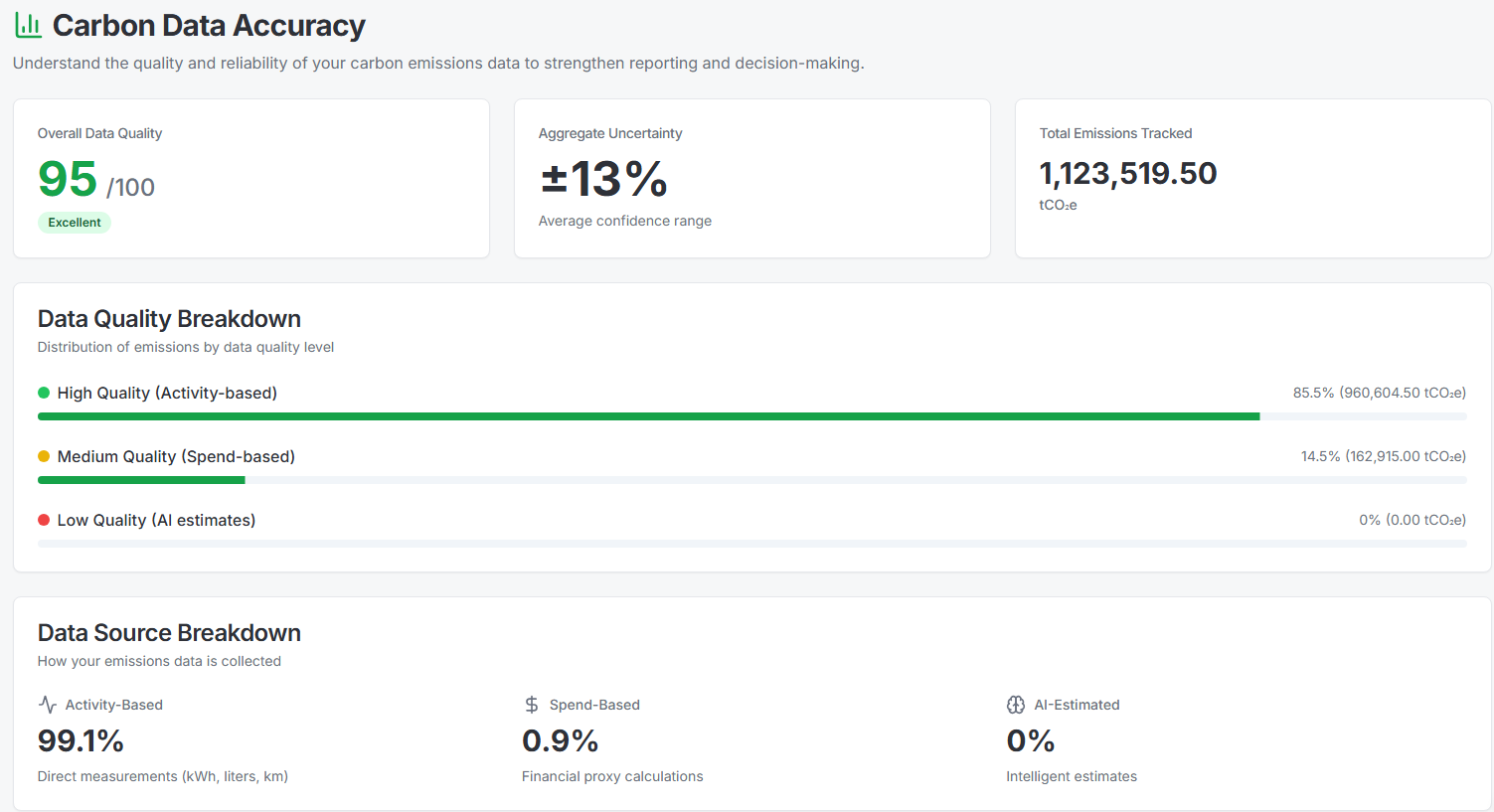
    Best practice
    Best-practice organisations clearly distinguish between actual data, estimates, and AI-assisted estimates — and track improvements in data quality over time.

    Real-world reality
    Perfect ESG data rarely exists, especially for Scope 3. Pretending otherwise often damages credibility when assumptions are challenged during assurance.

    What this means for you
    Trust. Stakeholders — investors, auditors, and regulators alike — value honesty and progress far more than polished figures that cannot be defended.


    6. Link ESG Targets to Real Initiatives and Measurable Outcomes

    Best practice
    High-performing organisations link ESG targets directly to initiatives, investment decisions, and delivery milestones — not just disclosure metrics.

    Real-world reality
    Many ESG reports show ambitious targets, but cannot clearly explain how those targets will be achieved or what progress has been made against them.

    What this means for you
    You can clearly demonstrate how strategy turns into action — and how action delivers measurable results. This is particularly important under CSRD, which requires disclosure of transition plans and progress indicators.


    7. Use AI as an Accelerator — Not a Black Box

    Best practice
    AI-powered automation is used transparently to:

    • Fill data gaps with auditable, source-referenced estimates
    • Identify anomalies and flag data quality issues before auditors do
    • Support narrative reporting with structured first drafts
    • Match activity data to emission factors automatically
    • Guide teams with contextual insight based on their own data

    Human oversight remains firmly in place — AI accelerates the work, but every output is reviewed and approved by your team.

    Real-world reality
    Uncontrolled AI outputs raise more questions than they answer — especially with auditors and regulators who need to understand how disclosures were produced.

    What this means for you
    You gain speed and insight without losing control or credibility. Teams that previously spent twelve to sixteen weeks on reporting can complete the same work in four to six weeks.


    8. Build One ESG Data Foundation — Then Report Many Ways

    Best practice
    Leading organisations create a single ESG data backbone that supports:

    • Internal management reporting
    • Board updates and executive dashboards
    • Investor disclosures and ESG ratings questionnaires
    • Regulatory submissions (CSRD, CDP, GRI, TCFD)

    Real-world reality
    When ESG data is rebuilt separately for each audience, inconsistencies appear — and confidence erodes. An investor sees one number, the board sees another, and the regulator sees a third.

    What this means for you
    One version of the truth, fewer reconciliations, and a consistent ESG story everywhere it is told.


    How to Choose ESG Reporting Software That Supports Best Practices

    Implementing these ESG reporting best practices is significantly easier with the right technology. When evaluating ESG reporting software, look for platforms that provide:

    • Centralised data collection — automated ingestion from ERP, HR, energy, and procurement systems
    • Full audit trail — every data point traceable to its source with change history
    • Multi-framework supportCSRD, GRI, CDP, TCFD, and ISSB from one data model
    • Carbon accountingScope 1, 2, and 3 with automatic emission factor matching
    • AI automationintelligent gap-filling, anomaly detection, and narrative support
    • Workflow management — role-based access, approval chains, and deadline tracking
    • Scalable pricingtransparent pricing that grows with your organisation

    Final Thought

    The strongest ESG leaders do not just report well — they manage well.
    When ESG reporting follows best practice, it becomes a source of confidence, control, and strategic advantage — not just another regulatory obligation. Book a demo to see how Horizon ESG puts these best practices into action.


    Frequently Asked Questions

    What are ESG reporting best practices?

    ESG reporting best practices are proven approaches that help organisations produce accurate, audit-ready sustainability disclosures. They include establishing clear data ownership, designing for auditability, using purpose-built ESG software, being transparent about data quality, and leveraging AI to accelerate reporting without losing control.

    What software do I need for ESG reporting?

    You need a purpose-built ESG reporting platform that handles multi-entity data collection, carbon accounting across all scopes, multiple reporting frameworks from one data model, and full audit trails. Spreadsheets do not scale for organisations reporting under CSRD, GRI, or CDP simultaneously.

    How do I prepare for CSRD reporting?

    Start by defining your reporting scope and conducting a double materiality assessment. Establish data ownership for every metric, ensure your systems can produce auditable data trails, and build processes for continuous data collection rather than year-end scrambles. Purpose-built ESG software significantly reduces the effort required.

    Can AI help with ESG reporting?

    Yes. AI-powered ESG tools can automate data collection, match activity data to emission factors, detect anomalies, fill data gaps with auditable estimates, and draft narrative disclosures. The key best practice is to keep humans in the loop — AI accelerates the work, but your team reviews and approves every output.

    How long does ESG reporting take?

    Without automation, a full ESG reporting cycle typically takes twelve to sixteen weeks. Organisations using AI-powered ESG reporting software can reduce this to four to six weeks by automating data collection, emission factor matching, and validation — freeing teams to focus on analysis and strategy rather than data wrangling.

Book Your Free Demo